Table of Contents
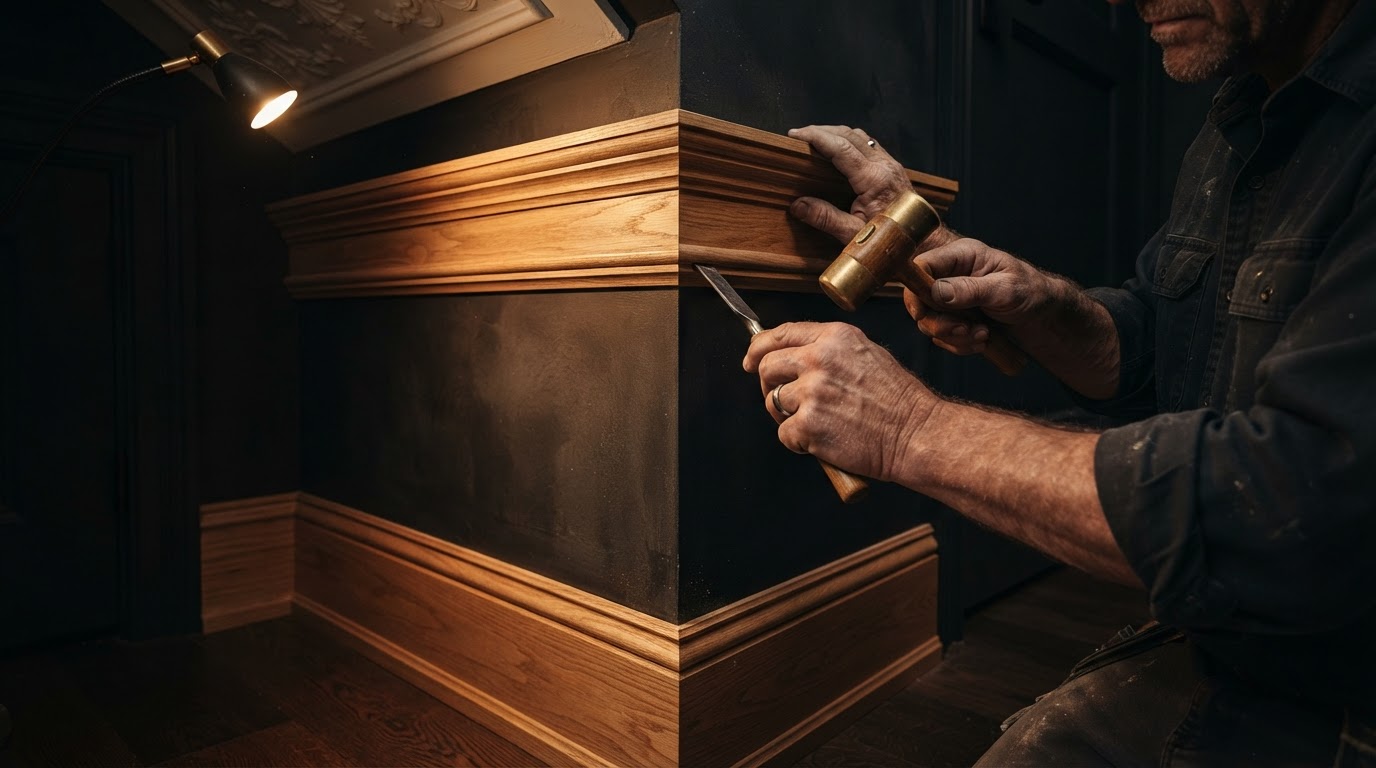
Base trim and door casing are the foundation of a room's trim work. They hide the gaps where the wall meets the floor and the door, and they give a room a finished edge. Even a plain room reads better with clean base and casing.
Base and casing, the foundation
Base trim and door casing are the foundation of a room's trim work. They hide the gaps where the wall meets the floor and the door, and they give a room a finished edge. Even a plain room reads better with clean base and casing.
The profile matters more than people expect. A flat, simple base suits a modern home. A stepped or contoured base suits a traditional one. Matching the trim to the era of the home keeps it feeling right rather than grafted on.
In an older Philadelphia home, the original trim is often worth preserving or matching. Old-growth trim with its grain and patina is hard to reproduce. When it is missing or damaged, we match the profile so the new work disappears into the old.
Crown molding, the ceiling finish
Crown molding finishes the joint where the wall meets the ceiling. It adds height and detail to a room, and in a traditional home it is often expected. In a modern home, a clean square reveal can be the better choice.
Crown is not right for every room. A low ceiling can feel lower with heavy crown. A room with a modern, minimal feel can be interrupted by ornate molding. The choice is about the room and the home, not about crown being inherently better.
When crown fits, the scale has to be right. A crown that is too small for a tall room looks thin. A crown that is too large for a low room feels heavy. We size the profile to the room so it looks intentional, not dropped in.
Wainscoting and beadboard, the wall detail
Wainscoting and beadboard add detail to the lower wall, which takes a lot of wear in a home. They protect the wall from chairs and scuffs in a dining room or a hallway, and they add character that paint alone does not.
Raised-panel wainscoting suits a formal, traditional home. Beadboard suits a more casual or cottage feel. Both can work in the right room, and both need to be scaled to the ceiling height and the room's style.
The height matters. Wainscoting that is too low looks like a stub. Too high and it fights the upper wall. We set the height to the room, often around a third of the wall, so it reads as a deliberate detail.
Matching the home's era
The trim work has to match the home. A Victorian rowhome wants different trim than a mid-century home or a new build. Grafting the wrong trim onto a home makes it feel inconsistent, like the parts do not belong together.
When we work in an older home, we look at what is there. The existing trim tells us what the home expects. Matching it, or complementing it, keeps the home coherent. Replacing it with a generic profile loses the character.
This is where craft shows. Milling a profile to match an existing trim, coping an inside corner so the joint stays tight through the seasons, scribing a base to a wavy floor. These are the details that separate trim that lasts from trim that opens up.
What to choose for your room
Start with the base and casing. They are the foundation, and a room without them looks unfinished no matter what else is there. From there, add crown if the room and the home call for it, and wainscoting where the wall needs protection or detail.
Do not add all of it everywhere. A room with heavy base, heavy crown, and full wainscoting can feel busy. Choosing the elements that serve the room keeps it feeling designed, not decorated.
We help you see the options in the actual room. Trim is hard to picture from a catalog. Seeing a sample profile on the wall, in the light, tells you more than any description. We bring the samples to you.
Does crown molding work on low ceilings?
It can, but the scale has to be right. A heavy crown on a low ceiling can feel oppressive. A smaller profile or a clean square reveal is often a better choice for a low room.
What is the difference between wainscoting and beadboard?
Wainscoting is the general term for lower-wall paneling. Beadboard is a specific style with vertical grooves that has a casual, cottage feel. Raised-panel wainscoting is more formal.
Can you match my home's original trim?
Often yes. We can mill a profile to match existing trim so the new work blends with the old. Matching the era of the home keeps the trim feeling coherent.
LET'S TALK ABOUT YOUR PROJECT
Tell us what you are planning. We will review the scope and follow up with next steps.